Artificial Intelligence · 8 min read
They Fired People for AI. Now They're Hiring Them Back.
Two in three employers that cut roles for AI are already rehiring. The data behind the reversal, and what the companies that kept their people did differently.
Bram van Gestel · Published 2026-08-28
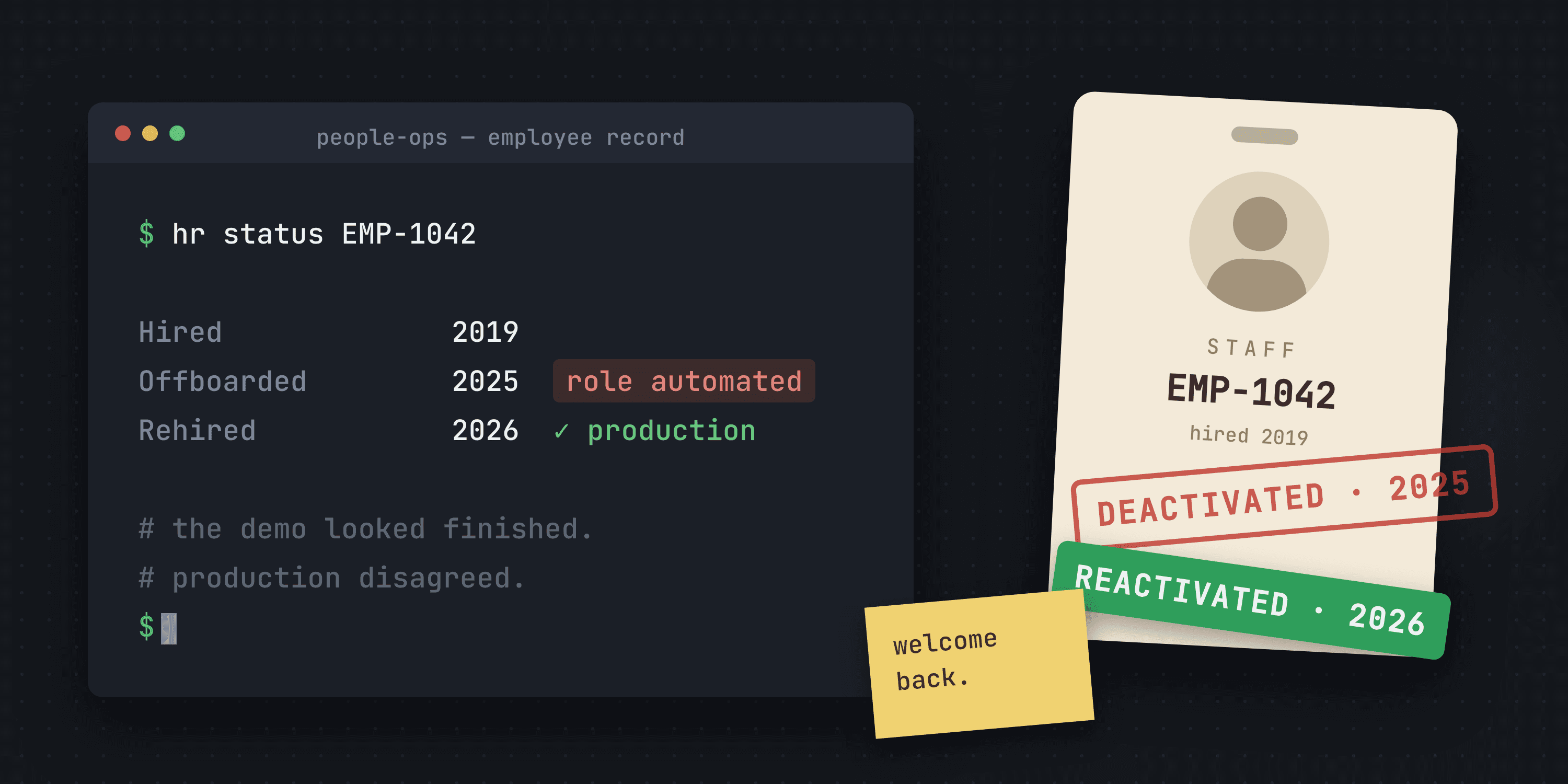
In February 2024, Klarna announced that its AI assistant was doing the work of 700 customer service agents. It handled 2.3 million conversations in its first month. For about a year, that press release was the slide in every board deck arguing that headcount and AI sit on opposite sides of the same ledger.
By mid 2025, Klarna was recruiting human agents again. CEO Sebastian Siemiatkowski said it plainly: the company had “focused too much on efficiency and cost”, and the result was lower quality. His new promise to customers: “there will always be a human if you want.”
One company reversing course is an anecdote. Then the surveys landed.
The numbers behind the rehiring wave
In February 2026, Careerminds surveyed 600 HR professionals who had made layoffs in the previous twelve months. Among the organizations that cut roles because of AI, 32.7 percent had already rehired for a quarter to half of the eliminated positions. Another 35.6 percent had rehired for more than half. Two in three, quietly refilling the desks they emptied. Over half were rehiring within six months of the layoff.
The line from that survey that stays with me: only 21.4 percent of these HR leaders said AI had fully replaced the eliminated roles without operational issues.
Orgvue asked 1,163 C-suite and senior leaders about the same period. Thirty-nine percent had made people redundant as a result of deploying AI. Of those, 55 percent admit they made the wrong decisions. The same survey suggests why: a quarter of leaders say they do not know which roles can benefit most from AI, and 30 percent do not know which roles are most at risk. The layoffs were decided before that homework was done.
Gartner has now put a date on the correction: it predicts that half of the companies that cut customer service staff because of AI will be rehiring those roles by 2027. In an earlier Gartner poll of 163 customer service leaders, 95 percent said they plan to retain human agents.
None of this is free. You pay severance on the way out and recruiting fees on the way back in, and the context that walked out the door does not return on day one.
What actually failed
It was not a model problem. MIT’s GenAI Divide report looked at more than 300 enterprise AI deployments and found that 95 percent of generative AI pilots produced no measurable P&L impact, across an estimated 30 to 40 billion dollars of spend. Gartner expects over 40 percent of agentic AI projects to be canceled by the end of 2027, and its stated reasons repeat across the post-mortems: runaway costs and risk controls that never got built. Gartner also counts thousands of vendors selling “agentic AI” and estimates only about 130 of them actually are.
Read the failure stories side by side and the same shape appears. A pilot that impressed in a demo went to production without the boring parts: nobody routed the exceptions to a person, nobody logged what the agents did, nobody could say what a workflow cost until the invoice arrived, and nobody had taught the system how the company actually works.
The layoff was decided against the demo. The rehiring was decided against production.
Customers noticed before the boards did. On Hacker News this month, someone opened a thread asking which AI companies still provide human support. As a purchasing criterion.
If knowledge stops being scarce, what are you selling?
The rehiring wave is the visible part. The slower shift underneath it is the one I keep coming back to.
Professional firms have always been in the scarcity business. What they charge for, knowing what to do in situations a client cannot judge alone, takes each expert a decade to absorb. That scarcity is what makes the billable hour defensible.
Put it on a balance sheet, though, and expertise held in a person is a strange asset. It commutes: it goes home at six and you hope it comes back in the morning. It serves a handful of clients at a time. And one day it retires, or takes an offer from the firm across town, and twenty years of absorbed judgment leaves with two weeks of notice.
Teach an agent the same material and the economics flip. Copy it and you have two. It keeps working after the office empties, and next quarter it still remembers every edge case you walked it through. Firms have started racing to get their way of working, and their memory of every client, into a form agents can actually use, which is a different animal from a shared drive full of PDFs. The ones doing it well are compounding an advantage, because their expertise no longer depends on which particular humans are in the building this year.
Several of them then draw the wrong conclusion: if the expertise now lives in the system, the experts must be overhead. But the agents only know what the experts taught them, and the teaching never stops, because the work keeps changing. Cut the experts and your scalable knowledge base starts aging the day they leave.
Something else survives the shift untouched. Once every firm’s agent can recite the same rules, knowing the rules is worth little. What a client keeps paying for is the person who knows their situation: their history, their appetite for risk, what they are actually asking underneath the question. An agent can draft the recommendation. Standing behind it, in front of a client who will remember who told them what, stays a human job.
Fire the people and you get agents with no teacher and decisions with no owner. Which is a fair summary of the failure data above.
Substitute or complement: the data splits cleanly
Stanford’s Digital Economy Lab has tracked AI’s employment effects since 2022 in a project called Canaries in the Coal Mine. Its headline finding usually gets quoted as doom: employment for workers aged 22 to 25 in the most AI-exposed occupations has fallen well behind their peers, a gap of about 19 percent by August 2026.
The part that gets quoted less is the split underneath. The declines concentrate in occupations where AI is used to substitute for human tasks. Where AI is used to complement people, employment is flat or rising, especially for experienced workers. Same technology, opposite outcomes. The variable is how companies chose to deploy it.
PwC sees the same split from the wage side. Its 2026 AI Jobs Barometer, built on over a billion job ads across 27 countries, found that workers with AI skills now earn a 62 percent wage premium, up from 57 percent a year earlier. Roles where AI magnifies expert judgment are growing twice as fast as roles where it simply automates tasks, with salaries rising 42 percent faster. And since 2022, the most AI-exposed companies have tripled their productivity-growth lead over the least exposed.
Your people, once they can work with AI, are literally worth more. The market has already priced the answer.
How to get the gains without the rehiring bill
What I would take from all of this, if a headcount decision were on my desk this quarter:
- Map the workflow before touching the org chart. Remember Orgvue’s numbers: most leaders who cut could not say which roles AI helps and which it threatens. That answer comes from mapping how the work actually runs, task by task, exceptions included. Do it first.
- Structure the knowledge. Agents are only as good as what your firm can feed them. Get the methods and the client context out of heads and inboxes and into something structured that agents can consume. The people who hold that knowledge are the only ones who can do this transfer. You need them.
- Keep judgment human by design. Route the decisions that carry risk to a person, and log what the agents did and who approved it. Make cost per workflow visible from week one. If these controls sound like optional extras, reread why Gartner says agentic projects get canceled.
- Upskill the people you have. They hold context no vendor can sell you, and the market now pays a documented premium for people who combine it with AI skills. In the Orgvue survey, 80 percent of leaders plan to reskill their workforce for AI. The ones who started early are on the right side of Stanford’s split.
- Buy experience where you lack it. MIT’s data shows external partnerships succeed roughly twice as often as internal builds. The difference is scar tissue: a partner who has shipped this before has already built the exception routing and the audit trail once, on someone else’s budget.
Full disclosure: I run AgentLabs, a studio that builds exactly these systems, human oversight and audit trails included, so read my incentives plainly. But the closest thing I have to proof did not come from a sales deck. When I led the AI transformation of a 40-person engineering organization, releases went up more than 30 percent. The number I am most proud of from that year has nothing to do with AI: zero voluntary turnover, twelve months straight. Nobody was replaced. The work got better, and people stayed.
AI should make work better for the people doing it. The rehiring wave is the market learning, at severance-plus-recruiting prices, what that sentence costs to ignore.
Also published on AI in Plain English.