
AI build studio for back-office workflows
We build AI agents that run your back-office workflows.
Any department, on the systems you already run. A person signs off where it matters, every run is on record, and your team owns it at the end.
The type of agents we build, and the workflows they can run.
Examples of what we can build, from finance to IT: in each one an agent does the steps and a person signs off. Then how an AI agent works when we build it with your team.
Invoice to approval
Invoice arrives
Agent reads it
- Supplier and amounts read
- Purchase order found
Checks your ERP
- Matched with the goods receipt
- Booking drafted
A person signs off
Booked, on record
Contract to first day
Signed contract arrives
Agent prepares the checklist
- Accounts and access prepared
- Welcome email drafted
Updates your HR system
- Employee record created
- First-day plan scheduled
The manager signs off
Onboarded, on record
Request to scheduled job
Request arrives
Agent classifies it
- Request read and classified
- Skills and parts matched
Checks the planning
- Free time slots found
- Planning proposal drafted
The planner signs off
Scheduled, on record
Question to answer
Customer question arrives
Agent finds the case
- Question understood
- Earlier case found
Checks your CRM
- Order and policy checked
- Answer drafted
A colleague signs off
Answered, on record
Request to purchase order
Purchase request arrives
Agent checks the budget
- Request and budget checked
- Specification completed
Matches your suppliers
- Approved suppliers compared
- Purchase order drafted
The buyer signs off
Ordered, on record
Access request to account
Access request arrives
Agent checks the role
- Role and need checked
- Access policy applied
Checks your directory
- Current rights looked up
- Access change prepared
The owner signs off
Access granted, on record
Where does AI create leverage?
Opportunity scan
- Observe + ask
- Systems + data
- Procedures + docs
Process mapping together What we build
- Rules → Code
- Judgment → Agent
- High stakes → Person
Build + test
Design with the people who run it
- Real business examples
- Quality · time · effort
Blueprint, you decide What we build
- Fail → Fix + retest
- Pass → Deploy
Deploy with the team
Work through real cases together
- Review + correct
Operate, maintain, improve What we build
- In the tools people already use
- Background agents
- Your team's AI
Run + improve
Run log
When something fails, we fix the
- Knowledge
- Instructions
- Workflow
Baseline → live results
- Cycle time
- Error rate
- Cost per run
Then
- Rerun the tests
- Your people
- AgentLabs
- The agent
Bring the workflow that runs on handoffs today.
We map it with the people who run it, and in a week you see it as a working example on your own data.
Start with one workflow in a weekHow we work
Two ways to work with us.
We build it with your team, or you hire our AI engineers to work independently with yours.
One week, on your own data and systems
A working example of one workflow, built on your own data and systems, as a preview of what a build would deliver. Plus a read of your stack, where AI creates leverage, and the risks, the value and the roadmap.
AI automation and agents in your workflows
One workflow, one department, or the whole back office. On the systems you already run, with the people who do the work today, guards and sign-off built in.
Time back, spent better
Your team stops doing the repetitive work by hand and stops hunting for information across systems and inboxes. Those hours come back, and they go to the work that needs a person: the customer, the exception, the decision. The same people get more done, and the work gets better.
Yours, documented and handed over
We write down how it works, train the people who will run it, and hand it over properly. A person still signs off where it matters and every run stays on record. When your team runs it without us, we are done, and that is how it should be.
The daily work has not changed yet.

Not adopted
Whether you have piloted AI or not started, the daily work runs the same way.

Still manual
Core work still runs on manual handoffs, spreadsheets, and inboxes.

Cost grows with revenue
Every new client or process means more headcount, so cost grows as fast as revenue.

No accountability
Nobody can show who approved what, what it cost, or what the agent actually did.
Built with the people who do the work today.
The people who run the process by hand now are the ones who run it with agents afterwards. They map it with us, they sign off on the gates, and they own it on day one, which is why it is still used a year later. The same team handles more work without more headcount, and you can see what each workflow costs to run.

What we learn building this.
10 Sept 2026
What Is an AI Agent? The Question I Get on Every Sales Call
The explanation I give prospects on a call: what an agent is, how the reasoning loop works, and a walk through AgentLabs' own outbound engine, human approval included.
28 Aug 2026
They Fired People for AI. Now They're Hiring Them Back.
Two in three employers that cut roles for AI are already rehiring. The data behind the reversal, and what the companies that kept their people did differently.
25 Jul 2026
Gates, not guidelines: building a product with AI agents that cannot cut corners
The pitch is that you wire up one agent and go ten times faster. That is not what happens. Here is the setup, tool by tool, that actually let AI agents write every line of my product’s code without quietly breaking a database full of customer data.
4 Aug 2026
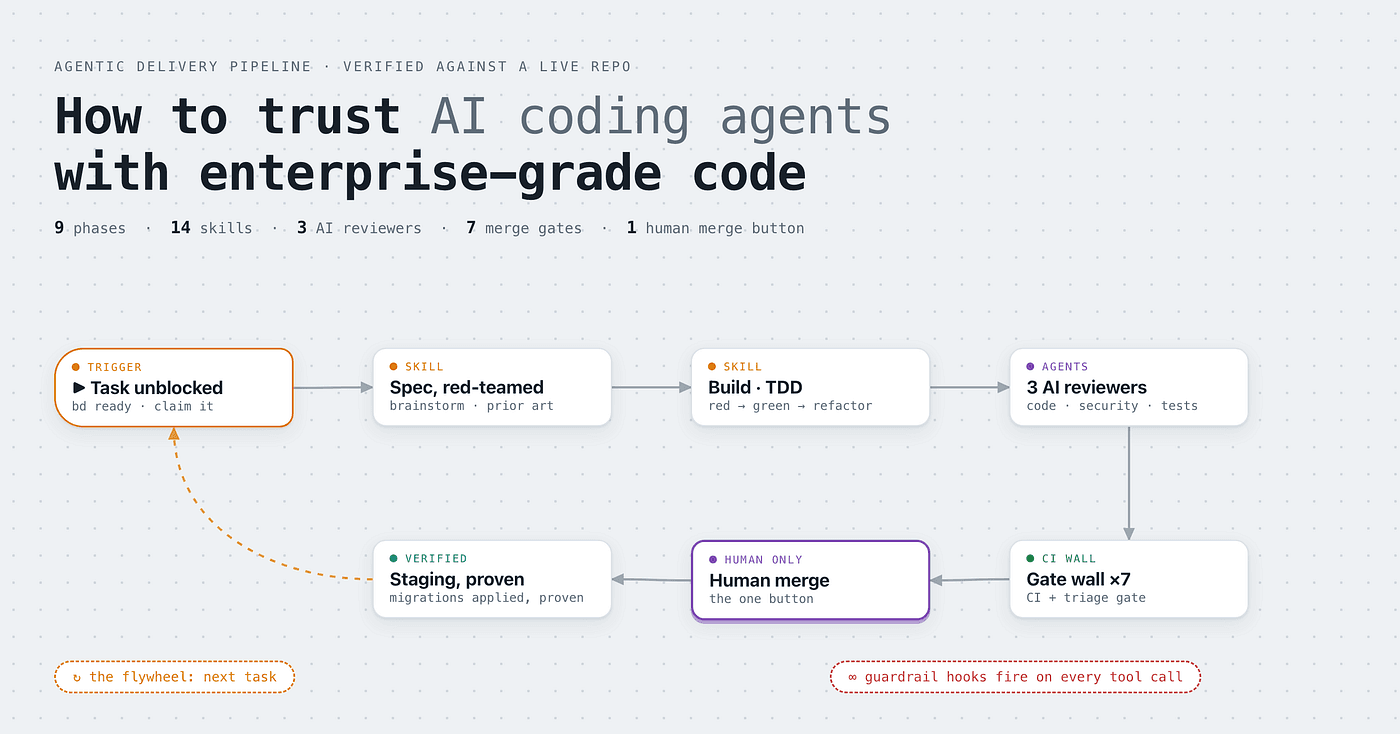
How I Trust AI Agents to Ship Enterprise-Grade Code Without Reviewing Every Line
The setup that earned that trust: nine phases, guardrail hooks, three AI reviewers, a seven-check gate wall, and the one button an agent can never press.
The people you talk to are the people who build it.
Operator experience, engineering leadership, and hands-on implementation in the same room. What you get is a working system your team can understand, operate, and improve.
Choose how to get started
The AI Opportunity Scan.
One week, fixed scope, one workflow. You leave with a working example of that workflow on your own data, as a preview of what a build would deliver, plus a map of where AI creates leverage, a read of your stack, and the risks, the value and the roadmap.
Start with one workflow in a weekBook a call.
Bring a process that is slow, manual, or fragmented. We will map where AI creates real leverage and what it takes to build it on top of what you already run.
Book a call